
TINUBU’S FIRM “NO”: A TEST OF DEMOCRATIC DISCIPLINE – Dr Charles Edet – SIXT-MEDIA LANE
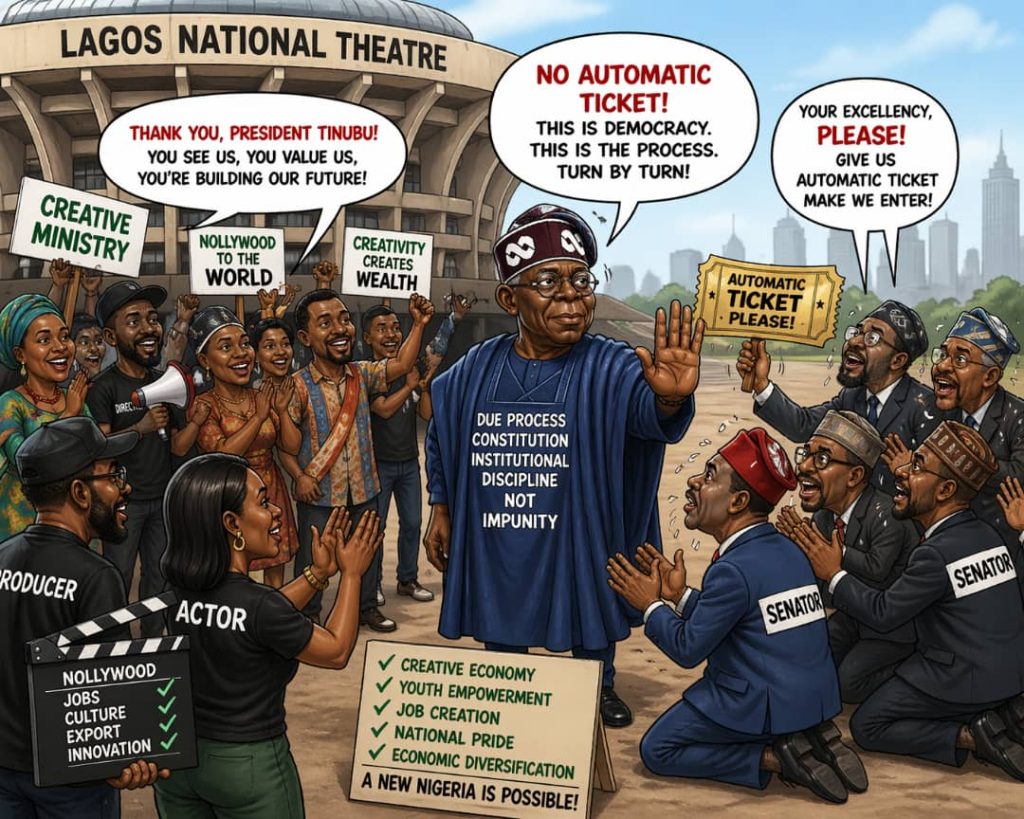
TINUBU’S FIRM “NO”: A TEST OF DEMOCRATIC DISCIPLINE.
By Charles Edet Esq, Fcr.
In a polity often strained by the push-and-pull of competing interests, moments that reaffirm constitutional order deserve sober attention rather than noisy partisanship. The reported rejection by President Bola Ahmed Tinubu of a senator’s request, for an automatic ticket to foster continuity, details notwithstanding, signals more than an isolated executive decision. It underscores a broader commitment to institutional discipline, due process, and the sanctity of democratic sequencing.
Democracy is not merely about outcomes; it is fundamentally about procedure. The doctrine of separation of powers demands that the executive, legislature, and judiciary operate within clearly demarcated boundaries. When the executive resists legislative pressure that appears to circumvent due process or distort established order, it strengthens—not weakens—the system. In that sense, refusing an improvident request is not obstinacy; it is constitutional fidelity.
History offers compelling parallels. Abraham Lincoln, during the turbulence of the Civil War, held firmly to constitutional principles despite immense political pressure. Nelson Mandela, at the dawn of a new democratic South Africa, resisted populist temptations that could have destabilised institutional balance. Even Olusegun Obasanjo, in Nigeria’s Fourth Republic, at critical junctures insisted on procedural order over expedient accommodation. These leaders understood that the durability of democracy rests on the courage to say “no” when “yes” would be politically convenient but institutionally corrosive.
Within this framework, the Tinubu presidency appears to be cultivating a governance ethos that privileges continuity anchored in law rather than arbitrariness driven by influence. Legislative governance, by its nature, is “turn-by-turn”, a structured progression of deliberation, consultation, and enactment. Any attempt to short-circuit that process risks undermining the legitimacy of outcomes. By declining such overtures, the presidency reinforces a crucial democratic lesson: no officeholder, however influential, should override institutional pathways.
Beyond the immediate optics of executive-legislative engagement, the administration’s broader policy orientation reveals an intriguing dimension of governance—economic diversification through cultural and creative capital. The deliberate elevation of the creative sector from the margins to a strategic pillar of national development marks a departure from orthodox economic thinking. By formalising structures, creating dedicated institutional frameworks, and integrating practitioners into governance conversations, the administration is signalling that innovation, entertainment, and culture are not peripheral luxuries but central economic drivers.
This approach echoes global best practices where the creative economy, film, music, digital arts, and content production have become major contributor to GDP and employment. Nigeria, with its globally recognised entertainment industry, particularly Nollywood, stands to benefit significantly from such policy inclusion. It is therefore unsurprising that segments of the creative community of entertainers actors, producers, and cultural entrepreneurs, have begun to articulate support for a government that recognises their economic relevance.
Figures like Emeka Rollas, former president of the Actors Guild of Nigeria, have framed this alignment not as blind endorsement but as strategic engagement. Their position suggests a pragmatic reading of governance: where policy direction aligns with sectoral growth, stakeholders have both the right and responsibility to mobilise support and shape public discourse. This is, in itself, a democratic exercise of citizens organising around interests and ideas rather than ethnic or partisan reflexes.
Yet, the critical question remains: can such engagements recalibrate Nigeria’s national narrative?
Scepticism is inevitable and necessary. Democracy thrives on scrutiny, not adulation. The test of leadership is not in isolated decisions or symbolic gestures but in sustained, measurable outcomes. Will the insistence on due process translate into stronger institutions? Will the creative economy initiatives yield tangible economic relief for citizens? Will inclusivity move beyond appointments to structural transformation?
What can be acknowledged, however, is the emerging pattern: a leadership attempting to balance political authority with institutional restraint, while simultaneously exploring unconventional economic frontiers. If consistently applied, this dual approach—constitutional discipline and economic innovation—could gradually reshape governance expectations in Nigeria.
In the final analysis, democracy is not defended by rhetoric but by restraint. And sometimes, the most consequential act of leadership is the quiet refusal to compromise the process.
About The Author


